From a Quick Charging Stop to Swiss History: My Encounter with General Guisan
A spontaneous stop in Avenches led me to discover the story of Switzerland’s last wartime general, Henri Guisan.
Walking from Roman Ruins to a General’s Monument
On our way home from visiting friends in the Canton of Vaud, we stopped in Avenches to charge our electric car—a town once known as Aventicum, the Roman capital of Helvetia.
While the car was charging, we wandered through the charming old town. Just before sunset, the historical town and the amphitheater looked peaceful, humble, and beautiful under the golden lights.
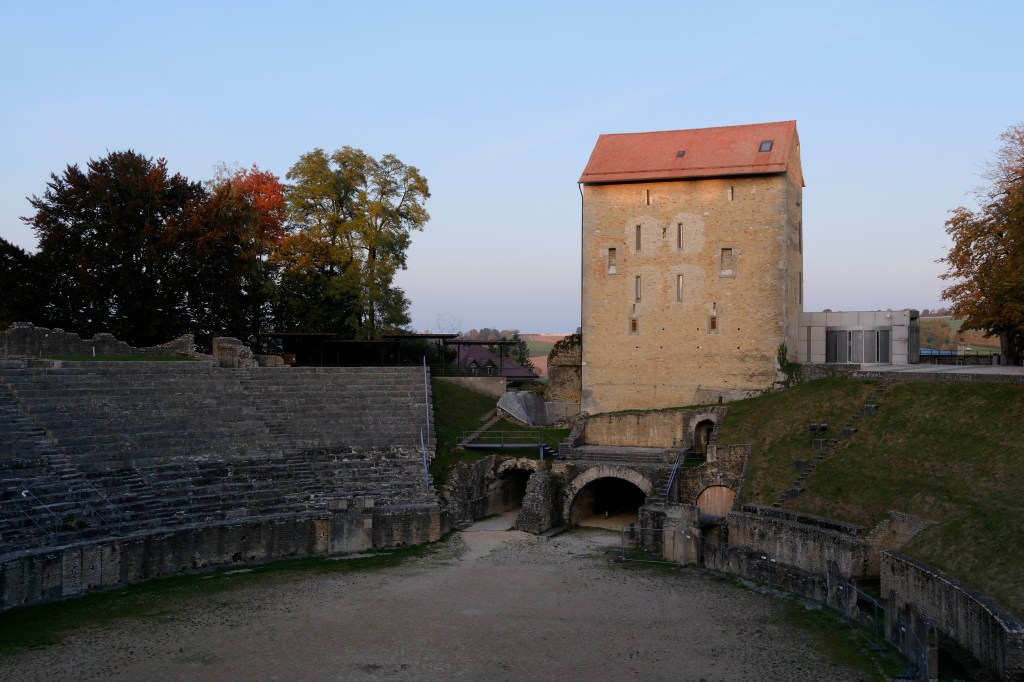
Avenches Amphitheater, one of the best-preserved Roman amphitheatres in Switzerland with 16’000 seats.Photo by me.
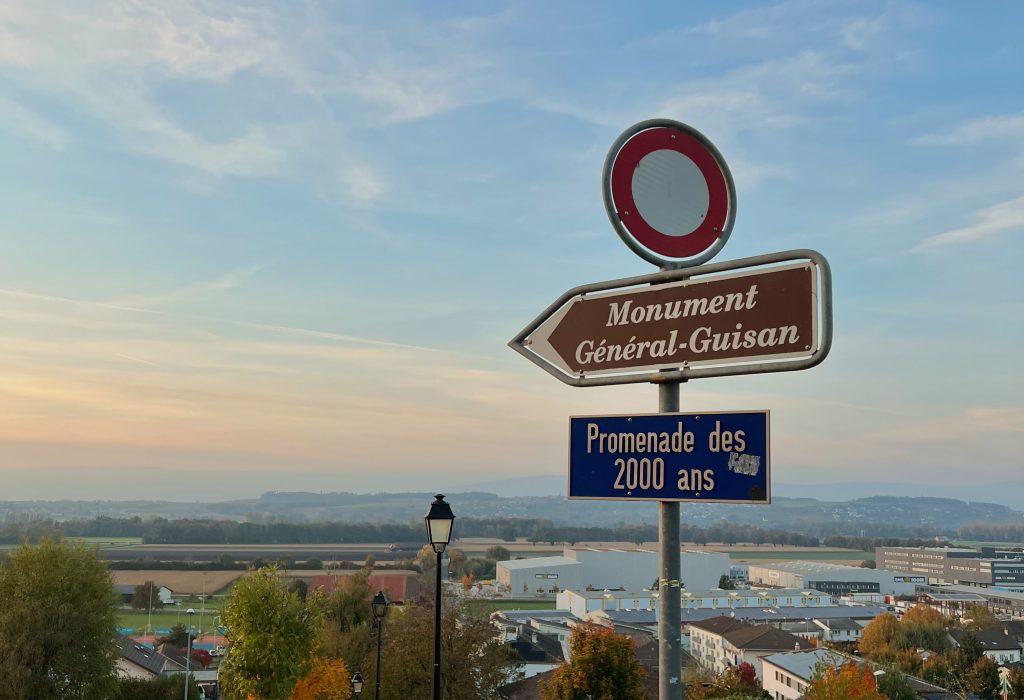
After visiting the amphitheater, we walked toward the town’s castle. While watching the sunset from its garden, we noticed a sign that read “Monument of General Guisan.” I didn’t know who he was. My husband explained, “He was an important general who led Switzerland’s resistance during World War II. Come, let’s see the monument.”
Signpost indicating the direction to the Monument of General Guisan in Avenches, Switzerland, photo by me.The monument of General Henri Guisan in Avenches, Switzerland, photo by me.
We went to see the monument; I learned a few things about him at the place. But then the weather was getting cold, we walked back to the car.
It fascinated me to see how a small town we had stopped in by chance, taught me about different layers of Swiss history: from Helvetia’s Roman times to Swiss resistance during WW2.
We drove home, but I was still curious about the man behind the monument. The next day, I looked him up, and this blog post was born.
An Impressive Life: From Farmlands to Battlefields
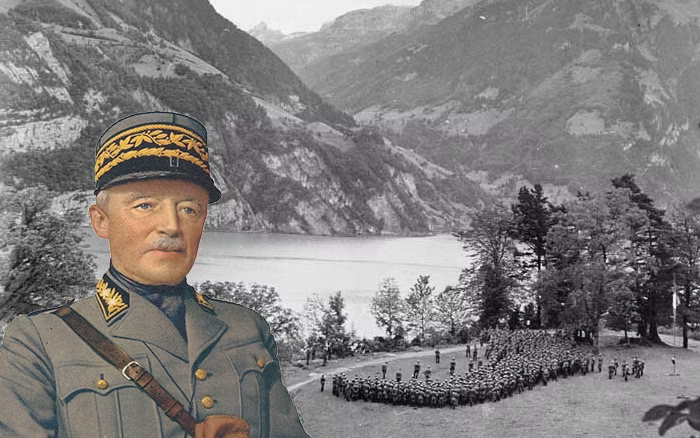
General Henri Guisan, prominent leader of Switzerland during World War II, alongside Swiss troops in a scenic mountainous backdrop. Image taken from Swiss Armed Forces, 2019.
As the son of a doctor and army major, Henri Guisan was born in Mézières in 1874. After studying agriculture in France and Germany, he became a successful farmer.
“He studied agriculture in Écully, France, and Hohenheim, Germany. In 1896 he bought the Bellevue estate in Chesalles-sur-Ollon, and in 1903 he moved to Verte Rive, where he lived as a gentleman farmer.“
(Swiss Armed Forces, 2019, para. 1).
After establishing himself as a landowner and farmer, Guisan also pursued a parallel military career. He rose through the ranks from field artillery lieutenant to General of the Swiss Armed Forces, appointed just before World War II in August 1939.
Leadership and Legacy
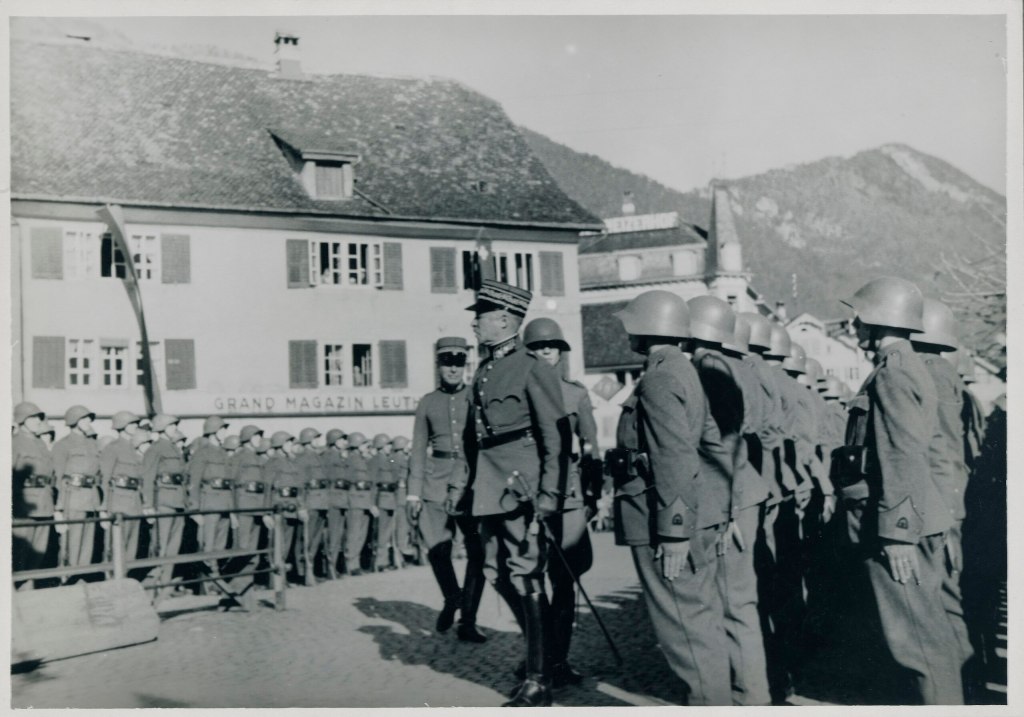
According to the article from Swiss Armed Forces, 2019, Guisan stood out among Swiss officers for his down-to-earth and decisive approach to leadership. Unlike many career officers, he often inspected soldiers directly in the field and rejected unnecessary protocol.
Guisan inspecting troops in Brunnen, Schwyz. Image is from ETH-Bibliothek Zürich, Bildarchiv.
“During the war, he did not distinguish himself as being a great strategist, but he listened to advisers, took decisions and risks, and defended his opinions firmly against political authorities and his subordinates. Above all, he was able to instill a spirit of resistance in both the military and the population by creating a symbiosis between these entities of Swiss society.”
(Swiss Armed Forces, 2019, para. 3).
Henri Guisan & Censorship
Guisan was a clever and strategic leader and wanted to take no unnecessary risks. He kept his whereabouts, home, and much of his work strictly confidential. So careful was he about his image that he banned the publication of any photograph without his approval. This measure helped both his security and his military success.
“To maintain his personal safety and to shield his own activities from prying eyes, Guisan the general heavily propagandised his public image. There were thus sound reasons for censorship, including image censorship.”
(Schlup, 2021)
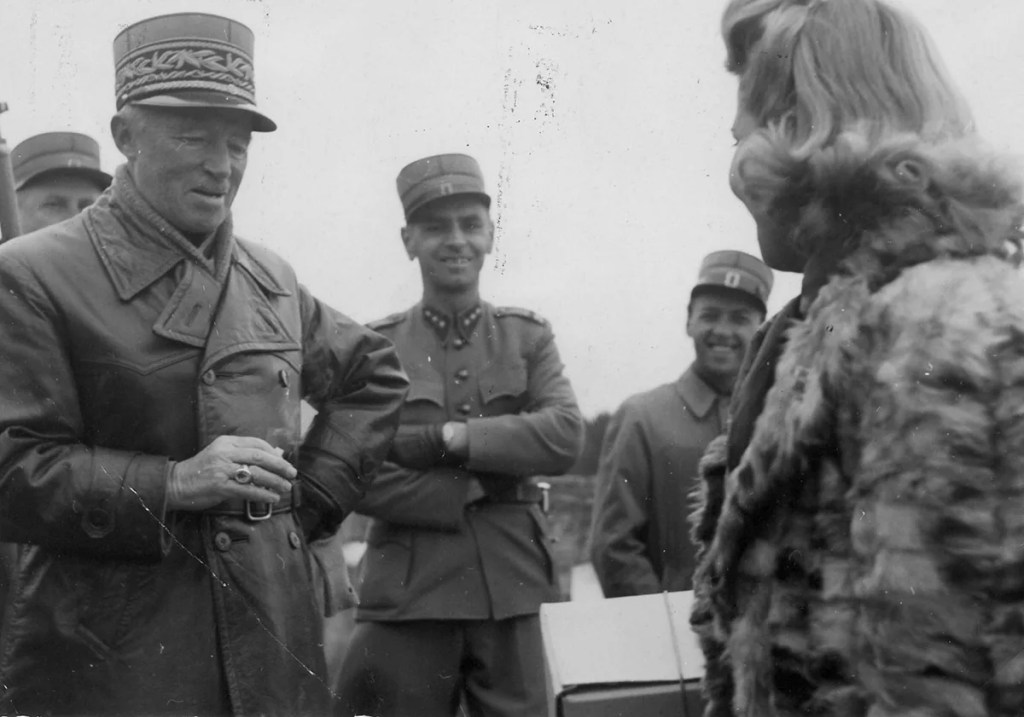
Interesting fact: He even prohibited the release of photos showing him smoking or chatting with women, as he believed such images could harm his reputation as a married man and national figure.
General Henri Guisan engaging with a woman holding a cigarette, this was one of the prohibited photos of him. Image taken from(Schlup, 2021)
From Commander to Citizen
After guiding Switzerland through its most uncertain years, Guisan returned to civilian life, continuing to serve his country in new ways.
“General Guisan was discharged from active military service on 20 August 1945. As an ordinary citizen he served on the boards of important organisations, such as the National Donation Foundation, the International Committee of the Red Cross, and other charitable organisations.”
(Swiss Armed Forces, 2019, para. 4).
Henri Guisan died in Pully on 7 April 1960. “During the war, General Guisan was unanimously supported throughout the country, and on the day of his funeral on 12 April 1960, more than 300,000 people, many of them veterans in uniform, took part in the funeral procession.” (Swiss Armed Forces, 2019). This respect continued long after his death. As Murielle Schlup (2021) notes on the Swiss National Museum Blog, Guisan was later voted Romand du siècle (French-Swiss man of the century) in 2011, proof that his legacy still resonates strongly today.
P.S. I was quite tired that evening and almost stayed in the car. I’m so glad I didn’t. That short walk through Avenches opened up a piece of Swiss history I knew so little about. Hope you enjoyed reading it too; a blog post that came to you thanks to a simple charging stop. 🙂
Resources
Swiss Armed Forces. (2019, July 25). Henri Guisan (1874 – 1960). Federal Department of Defence, Civil Protection and Sport. Retrieved October 19, 2025, from https://www.vtg.admin.ch/en/henri-guisan-1874–1960


 Semiha Weber
Leave a comment